In industrial and automotive applications, material quality plays a major role in ensuring smooth operations…

- 6 minute read
- Mehul Tolia
- Product Guide
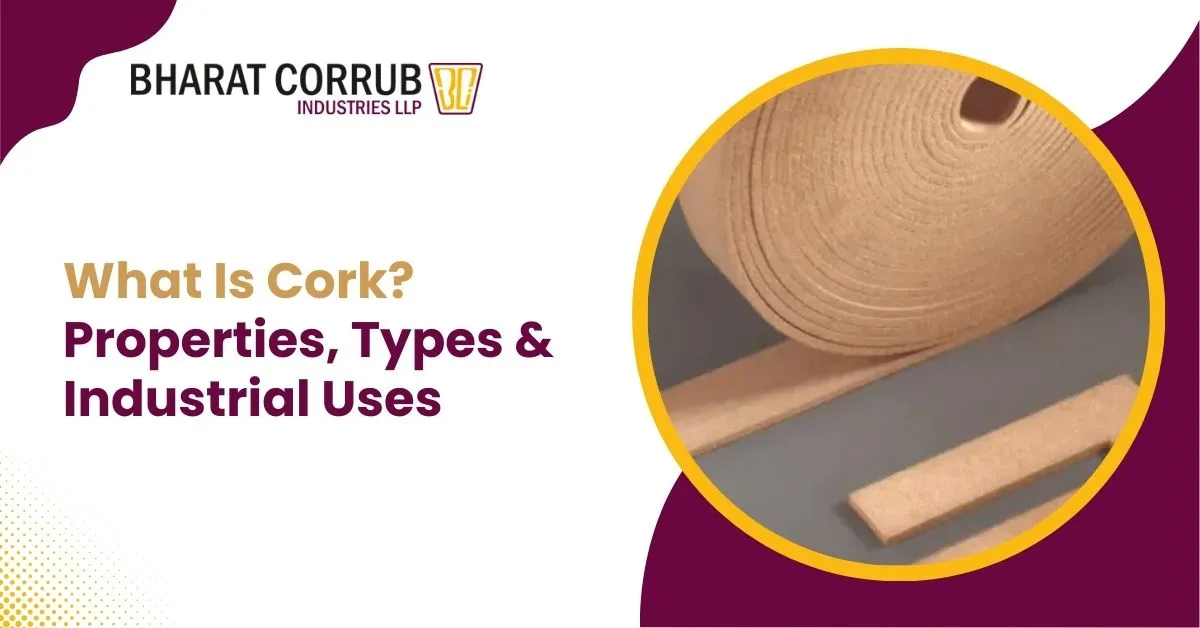
Cork is a natural, versatile material that has been used for centuries, yet it continues to play a vital role in modern industries. Known for its lightweight structure, insulation capability, and sustainability, cork is widely used in sealing, insulation, vibration control, construction, electrical applications, and manufacturing. As industries move toward durable and eco-friendly materials, cork has emerged as a reliable solution that balances performance with environmental responsibility.
This guide explains what cork is, its key properties, the different types of cork, and how cork is used across various industrial applications.
What Is Cork?
Cork is a natural material obtained from the bark of the cork oak tree (Quercus suber). The bark is harvested without cutting down the tree, making cork a renewable and sustainable resource. After harvesting, the bark regenerates naturally, allowing repeated extraction over the tree’s lifespan.
Cork’s internal structure consists of millions of microscopic, air-filled cells. These cells give cork its unique characteristics such as compressibility, elasticity, insulation, and resistance to moisture. Unlike many synthetic materials, cork retains its properties over long periods, even under repeated compression.
Properties of Cork
Cork’s wide industrial use is driven by its unique combination of physical and mechanical properties:
1. Compressibility and Recovery
Cork can compress under pressure and recover its original shape when the load is removed. This makes it ideal for sealing and gasketing applications where maintaining contact pressure is essential.
2. Thermal Insulation
The air trapped inside cork cells reduces heat transfer, making cork an effective thermal insulation material for industrial, electrical, and construction applications.
3. Acoustic and Vibration Damping
Cork absorbs sound waves and mechanical vibrations, reducing noise transmission and protecting equipment from vibration-induced damage.
4. Lightweight Structure
Despite its strength, cork is lightweight, which helps reduce overall system weight in automotive, machinery, and construction projects.
5. Moisture and Rot Resistance
Cork does not absorb water easily and is resistant to rot, mold, and microbial growth, making it suitable for humid or damp environments.
6. Chemical and Aging Resistance
Cork resists many oils, fuels, and chemicals and does not easily degrade with age, ensuring long service life.
7. Eco-Friendly and Sustainable
Cork is biodegradable, recyclable, and harvested with minimal environmental impact, making it a preferred material for sustainable manufacturing.
Looking for high-quality cork solutions for industrial applications? Contact us today for expert guidance and reliable products.
Types of Cork Used in Industry
Different forms of cork are produced to meet specific industrial requirements:
1. Natural Cork
Natural cork is used where minimal processing is required. It is commonly used in stoppers, insulation boards, and decorative applications.
2. Agglomerated Cork
Agglomerated cork is made by bonding cork granules together using binders. It offers consistent density and strength, making it suitable for industrial sheets, rolls, and blocks.
3. Rubber Cork
Rubber cork combines cork granules with rubber binders to enhance flexibility, durability, oil resistance, and vibration damping. It is widely used for gaskets, seals, vibration pads, and industrial insulation.
4. Cork Sheets and Rolls
Cork sheets and rolls are manufactured in uniform thicknesses for use in insulation, gasketing, flooring underlays, and electrical applications.
5. Cork Granules and Cork Powder
Granulated cork and cork powder are used in composites, coatings, fillers, friction materials, and specialty industrial products.
Industrial Uses of Cork
Cork is widely used across industries due to its natural insulation, compressibility, and vibration-damping properties. These characteristics make it suitable for demanding industrial environments.
1. Sealing and Gasketing
Cork is widely used in gaskets and seals for pumps, compressors, transformers, gearboxes, and HVAC systems. Its ability to conform to uneven surfaces and maintain compression makes it ideal for leak prevention.
2. Electrical and Transformer Applications
Cork sheets are used for electrical insulation, vibration control, and sealing in transformers, switchgear, and control panels due to their thermal resistance and dielectric properties.
3. Vibration and Noise Control
Cork and rubber cork materials are used under machinery bases, generators, compressors, and HVAC equipment to absorb vibration and reduce noise transmission.
4. Construction and Infrastructure
In construction, cork is used for thermal insulation, acoustic panels, flooring underlays, expansion joints, and structural vibration isolation.
5. Automotive Industry
Cork is used in automotive gaskets, vibration pads, insulation components, and sealing applications where durability and noise reduction are critical.
6. Industrial Flooring and Underlays
Cork underlays reduce impact noise, improve comfort, and protect structural flooring from vibration and stress.
7. Sustainable and Green Applications
Due to its renewable nature, cork is increasingly used in green building projects, eco-friendly manufacturing, and energy-efficient systems.
Cork vs Synthetic Materials
Compared to fully synthetic materials, cork offers:
- Lower environmental impact
- Better insulation efficiency
- Long service life with minimal degradation
- Natural resistance to vibration and noise
These advantages make cork a strategic material choice for industries seeking performance with sustainability.
Frequently Asked Questions
Yes. Cork is widely used in sealing, insulation, vibration control, and electrical applications due to its durability and performance.
Yes. Cork is renewable, recyclable, and harvested without harming trees, making it highly sustainable.
Yes. Cork’s compressibility and recovery allow it to perform well under pressure and vibration.
Conclusion
Cork is far more than a traditional material—it is a high-performance, sustainable solution for modern industrial challenges. With properties like compressibility, insulation, vibration damping, durability, and environmental responsibility, cork continues to prove its value across sealing, electrical, automotive, construction, and manufacturing industries.
As industries move toward long-lasting and eco-conscious materials, cork remains a smart, future-ready choice that delivers both performance and sustainability.
Mehul Tolia
Mehul Tolia is a Partner at Bharat Corrub Industries LLP (BCI), a leading manufacturer and exporter of cork and rubber cork products in India. With nearly a decade of experience, he has been a driving force behind BCI’s business development, product innovation, and process optimization initiatives. His leadership emphasizes quality, sustainability, and customer satisfaction, helping BCI strengthen its global presence. As a member of CII Young Indians (Yi) Vadodara), Mehul is passionate about fostering industrial growth and promoting innovation within the manufacturing sector.