Skip to content
Rubber Cork Sheet Tax Details

Understanding Rubber Cork Sheet tax details is essential for manufacturers, suppliers, exporters, and industrial buyers dealing with sealing, insulation, and anti-vibration materials. With recent changes under GST 2.0, rubberised cork products are no longer taxed uniformly, and incorrect classification can lead to higher tax outflow, compliance issues, or GST notices.

What Are Rubber Cork Sheets?

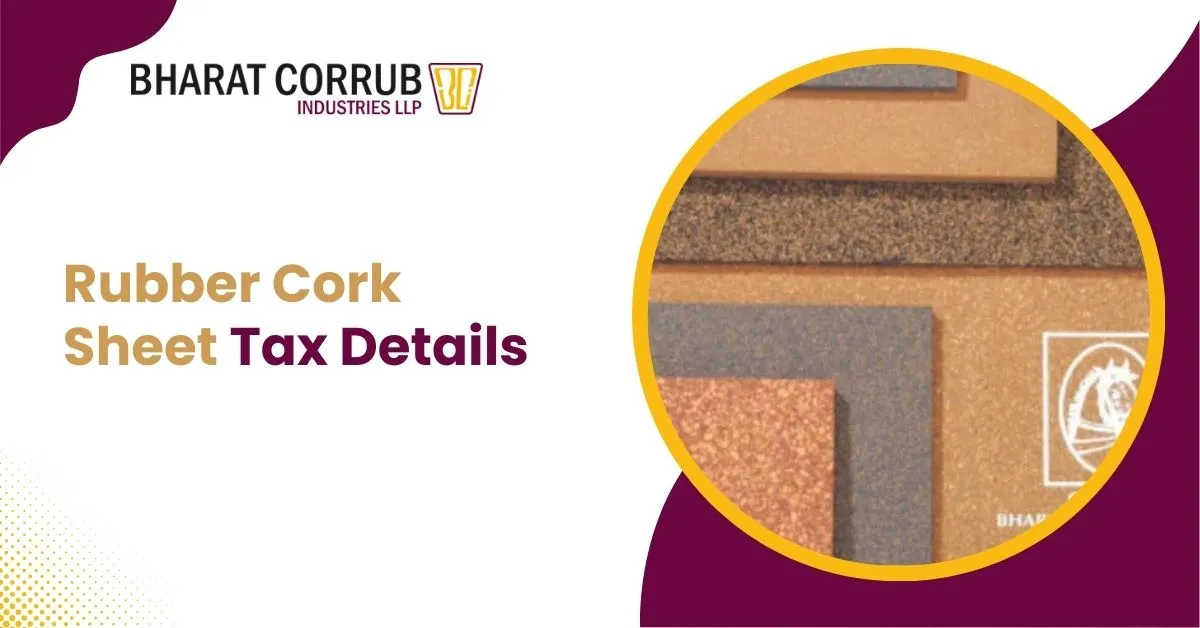
Rubber cork sheets are composite industrial materials made by bonding agglomerated cork granules with rubber binders. The cork provides compressibility and vibration absorption, while rubber improves strength, flexibility, and durability.

Common Applications

Rubber cork products are widely used in:

  • Air conditioners and refrigeration units
  • Diesel generator sets
  • Compressors and impact presses
  • Automotive sealing and insulation
  • Small and medium vibrating machinery

Because these products vary in form, function, and end use, their HSN classification and GST rate also vary.

Why Rubber Cork Sheet Tax Classification Matters?

Correct GST classification ensures:

  • Accurate GST rate application
  • Smooth e-way bill and invoicing
  • Eligibility for proper Input Tax Credit (ITC)
  • Lower audit and litigation risk

Under GST, classification is based on:

  • Material composition
  • Essential character of the product
  • Product form (sheet, strip, gasket, component)
  • How the product is billed and described

Rubber Cork Sheet HSN Code & GST Rate (2026)

Below is the updated and correct HSN–GST mapping for rubberised cork products as applicable in 2026:

Product Category HSN Code 2026 GST Rate Notes
Rubberised Cork Sheets 4504 1010 5% Moved from 12% to the 5% merit slab under GST 2.0
Rubberised Cork Strips / Other 4504 1090 5% Classified as agglomerated cork goods
Rubberised Cork Gaskets 4016 9340 18% Standard rate for vulcanised rubber articles
Transformer Gasket Sheets 8504 9010 18% Applicable when billed as specific transformer components

This table highlights that rubber cork products cannot be taxed under a single HSN code.

Looking for high-quality rubberised cork sheets and gaskets with correct GST and HSN compliance? Contact us today for engineered solutions for industrial and automotive needs

Why Rubberised Cork Sheets Fall Under HSN 4504?

HSN Chapter 45 covers cork and articles of cork, including agglomerated cork with or without a binding substance.

Rubberised cork sheets and strips qualify under HSN 4504 when:

  • Cork gives the essential character
  • Rubber is used mainly as a binder
  • The product is supplied as rubber cork sheets, rolls, or strips
  • Usage is general industrial sealing or vibration control

With GST 2.0, these products have been shifted to the 5% merit slab, reducing tax burden for manufacturers and OEM buyers.

Rubberised Cork Gaskets: Why GST Is 18%

Rubberised cork gaskets are often shaped, cut, or moulded for sealing applications. When these products function primarily as rubber sealing articles, they are classified under HSN 4016.

Key indicators for HSN 4016:

  • Rubber performance dominates over cork
  • Product behaves like a vulcanised rubber gasket
  • Sold specifically as a gasket or sealing component

Under this category, the applicable GST rate remains 18%, consistent with other industrial rubber articles.

Transformer Gasket Sheets: Special Classification Rule

When rubber cork sheets are:

  • Designed specifically for transformers
  • Rubber Cork Sheets are Cut or supplied as dedicated transformer components
  • Invoiced as part of electrical equipment supply

They fall under HSN 8504, which covers transformers and their parts.

In such cases:

  • GST rate is 18%
  • Classification depends heavily on billing description and documentation

Input Tax Credit (ITC) on Rubber Cork Products

Businesses registered under GST are eligible to claim Input Tax Credit (ITC) on rubber cork sheets, gaskets, and related products, subject to correct classification and usage.

ITC can be availed when:

  • The correct HSN code (4504, 4016, or 8504 as applicable) is mentioned on the invoice
  • GST on Rubber Cork Products is charged at the applicable rate (5% or 18%)
  • Goods are used for business, manufacturing, or export purposes
  • The supplier has filed corresponding GST returns

Correct HSN classification is critical, as wrong tax rates or misclassification may lead to ITC denial or reversal during audits.

GST on Export of Rubber Cork Sheets & Refund Eligibility

Exports of rubber cork sheets, gaskets, and components are treated as zero-rated supplies under GST.

Exporters can choose either of the following options:

  • Export under LUT (Letter of Undertaking) without payment of IGST and claim refund of accumulated ITC
  • Export with payment of IGST and claim refund of the IGST paid

Key requirements for smooth GST refunds for Rubber Cork:

  • Consistent HSN code usage across invoices, shipping bills, and GST returns
  • Accurate product description matching the export documentation
  • Proper linkage between export invoices and refund applications

Correct classification under HSN 4504, 4016, or 8504, based on product form and billing, helps avoid refund delays or rejections.

Common GST Classification Mistakes to Avoid

  • Applying 18% GST to plain rubberised cork sheets
  • Using HSN 4504 for shaped gaskets
  • Billing transformer gasket sheets as general rubber cork sheets
  • Using inconsistent HSN codes across invoices and returns

Such mistakes often trigger GST scrutiny and notices.

Frequently Asked Questions

Rubberised cork sheets under HSN 4504 1010 attract 5% GST as per GST 2.0.

No. Rubberised cork gaskets classified under HSN 4016 9340 attract 18% GST.

Yes. Form, function, and billing description significantly impact classification.

Yes, ITC can be claimed if the purchase is for business use and invoicing is correct.

They are classified as specific transformer components under HSN 8504.

Conclusion

The Rubber Cork Sheet tax structure in 2026 clearly distinguishes between cork-dominant sheets, rubber-dominant gaskets, and equipment-specific components. With rubberised cork sheets now falling under the 5% GST merit slab, correct HSN classification can result in significant tax savings.

For manufacturers and suppliers, aligning product composition, documentation, and invoicing with the correct HSN code is the key to compliance, ITC eligibility, and audit safety.

Mehul Tolia is a Partner at Bharat Corrub Industries LLP (BCI), a leading manufacturer and exporter of cork and rubber cork products in India. With nearly a decade of experience, he has been a driving force behind BCI’s business development, product innovation, and process optimization initiatives. His leadership emphasizes quality, sustainability, and customer satisfaction, helping BCI strengthen its global presence. As a member of CII Young Indians (Yi) Vadodara), Mehul is passionate about fostering industrial growth and promoting innovation within the manufacturing sector.

Rubber Cork Insights and Trends
1. Rubber Cork Sheet Tax Details
2. Sustainable and Eco-Friendly Benefits of Rubber Cork
3. Latest Trends in Rubber Cork Applications
4. How to Store & Maintain Rubber Cork Products?
5. Why Rubber Cork Gaskets Fail & How to Prevent It?
6. Rubber Cork Quality Standards & Certifications
7. Rubber Cork HSN Code & GST Rate
8. Rubber Cork Price in India: Factors & Guide
9. Rubber Cork Manufacturing Process Explained
10. Rubber Cork Thickness, Density & Specifications Guide
11. How to Choose the Right Rubber Cork Material?
12. Rubber Cork vs Neoprene Gaskets
13. Rubber Cork vs Rubber Sheet: Which Is Better?
14. Rubber Cork vs Plain Cork: Key Differences Explained
15. Rubber Cork for Noise & Vibration Control
16. Rubber Cork for HVAC, Compressors & Pumps
17. Rubber Cork in Transformers & Electrical Equipment
18. Rubber Cork for Automotive Industry Applications
19. Rubber Cork Strip & Angles for Leak-Proof Gaskets
20. Rubber Cork Gasket: Why It’s Ideal for Industrial Sealing
21. Rubber Cork Roll: Applications in Sealing & Vibration Control
22. Rubber Cork Sheet: Properties, Uses & Benefits
Back To Top