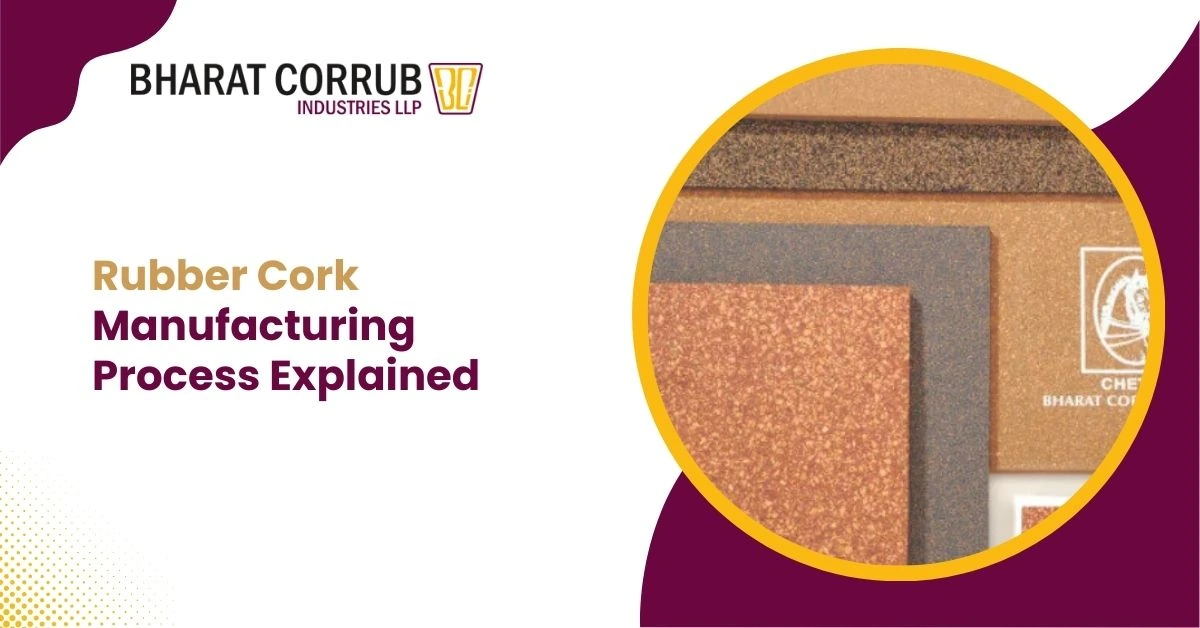
Rubber cork is a high-performance composite used for industrial gaskets, vibration isolation pads, sealing strips, and noise-control materials. Its unique properties come from a carefully controlled manufacturing process that combines natural cork and rubber into a durable, flexible, and reliable sealing material. Understanding how rubber cork is made helps engineers and buyers choose the right grade for sealing, insulation, and vibration control.
What Is Rubber Cork?
Rubber cork is produced by bonding granulated natural cork with rubber binders such as nitrile, neoprene, or EPDM. Cork provides compressibility and resilience, while rubber adds strength, flexibility, and resistance to oils, heat, and moisture. This combination creates a material that seals uneven surfaces, absorbs vibration, and performs reliably in harsh industrial environments.
Why the Rubber Cork Manufacturing Process Matters?
The manufacturing process determines the density, compressibility, strength, and durability of rubber cork. Precise control of granule size, rubber content, and curing conditions ensures that the final product delivers low squeeze-out, high vibration damping, and consistent sealing performance.
Step 1: Cork Granule Preparation
Natural cork bark is cleaned, ground, and graded into fine granules. Uniform granule size is essential for consistent compression and surface conformity in the finished rubber cork sheet.
Step 2: Rubber Binder Mixing
The cork granules are mixed with a rubber compound such as nitrile or neoprene. The rubber coats each cork particle, forming a flexible bonding matrix that provides strength and fluid resistance.
Step 3: Molding & Compression
The rubber-cork mixture is placed into Molds and compressed under controlled pressure. This step defines the thickness, density, and shape of the rubber cork sheet, roll, or block.
Step 4: Heat Curing (Vulcanization)
Heat is applied to cure the rubber, permanently bonding the cork and rubber together. This step gives rubber cork its elasticity, durability, and resistance to compression set.
Step 5: Sheet Cutting & Finishing
After curing, rubber cork is cut into sheets, rolls, strips, or custom gaskets. Quality checks ensure proper thickness, density, and surface finish.
Rubber Cork Manufacturing Process Explained
Rubber cork is a high-performance industrial material used for gaskets, vibration isolation pads, acoustic insulation, and sealing strips. Its unique ability to combine compressibility, strength, oil resistance, and vibration absorption comes from a carefully controlled manufacturing process. Every step—from selecting cork to curing the rubber—directly affects the final quality and performance of the product.
Selection and Preparation of Cork Bark
Rubber cork production begins with the harvesting of natural cork bark from cork oak trees. The bark is removed without harming the tree, making cork a renewable and eco-friendly resource.
The harvested cork bark is:
- Cleaned to remove dust and impurities
- Dried to remove moisture
- Ground into fine cork granules
These granules are carefully graded by size. Uniform granule size ensures even compression, smooth surface finish, and consistent density in the final rubber cork material.
Blending Cork Granules with Rubber Binders
Once prepared, cork granules are mixed with industrial rubber binders such as:
- Nitrile rubber (for oil and fuel resistance)
- Neoprene rubber (for flexibility and weather resistance)
- EPDM rubber (for water, heat, and ozone resistance)
The rubber coats every cork particle, forming a flexible bonding network. This step is critical because it determines:
- How well the cork particles hold together
- The material’s resistance to oil and moisture
- The flexibility and durability of the final product
Forming and Compression Molding
The rubber-cork mixture is then placed into Molds and compressed under controlled pressure. During this stage:
- The thickness of the sheet is set
- The density is controlled
- The overall structure of the material is formed
Proper compression ensures the rubber cork will have uniform strength, controlled porosity, and consistent performance.
Heat Curing (Vulcanization)
The molded rubber cork is exposed to high temperature in a curing chamber. This process, known as vulcanization, permanently bonds the rubber to the cork.
Curing gives rubber cork:
- Elasticity and resilience
- Resistance to compression set
- Long-term durability
- Chemical and oil resistance
Without proper curing, rubber cork would lose its shape, become brittle, or fail under pressure.