Choosing the right gasket or sealing material plays a critical role in preventing leaks, improving equipment reliability, controlling vibration, and reducing maintenance costs. That is why engineers, maintenance teams, and buyers often compare rubber cork vs rubber sheet when selecting materials for flanges, covers, housings, and industrial joints.
Although both materials are commonly used in sealing applications, they behave very differently when exposed to compression, vibration, pressure, and long-term mechanical stress. Rubber cork is designed to provide stable compression and vibration damping, while rubber sheet offers solid elastomeric sealing and lining. Understanding how these two materials perform under real operating conditions helps you choose the best option for improved sealing performance, longer service life, and reduced downtime.
Rubber Cork vs Rubber Sheet for Industrial Sealing
In industrial sealing, the material must do more than simply block leaks—it must compress evenly, conform to surface irregularities, and maintain sealing pressure over time. Many flanges and covers are not perfectly flat, and vibration from pumps, compressors, and motors can loosen joints if the gasket material cannot absorb movement.
Rubber cork is often preferred in these conditions because it combines the compressibility of cork with the strength and flexibility of rubber. This allows rubber cork to fill small gaps and uneven surfaces while resisting lateral squeeze-out under bolt load. It also absorbs vibration, helping the joint stay tight for longer periods.
Rubber sheet, on the other hand, is a solid elastomer. It seals well on smooth, well-machined surfaces and is widely used for general gaskets, linings, and protective barriers. However, depending on its hardness and formulation, rubber sheet may experience more side flow and compression set when used under heavy or uneven bolt loads.
This is why rubber cork is typically chosen for flanges, inspection covers, and vibrating machinery, while rubber sheet is more commonly used for flat sealing surfaces, lining, and general-purpose sealing applications.
What Is Rubber Cork?
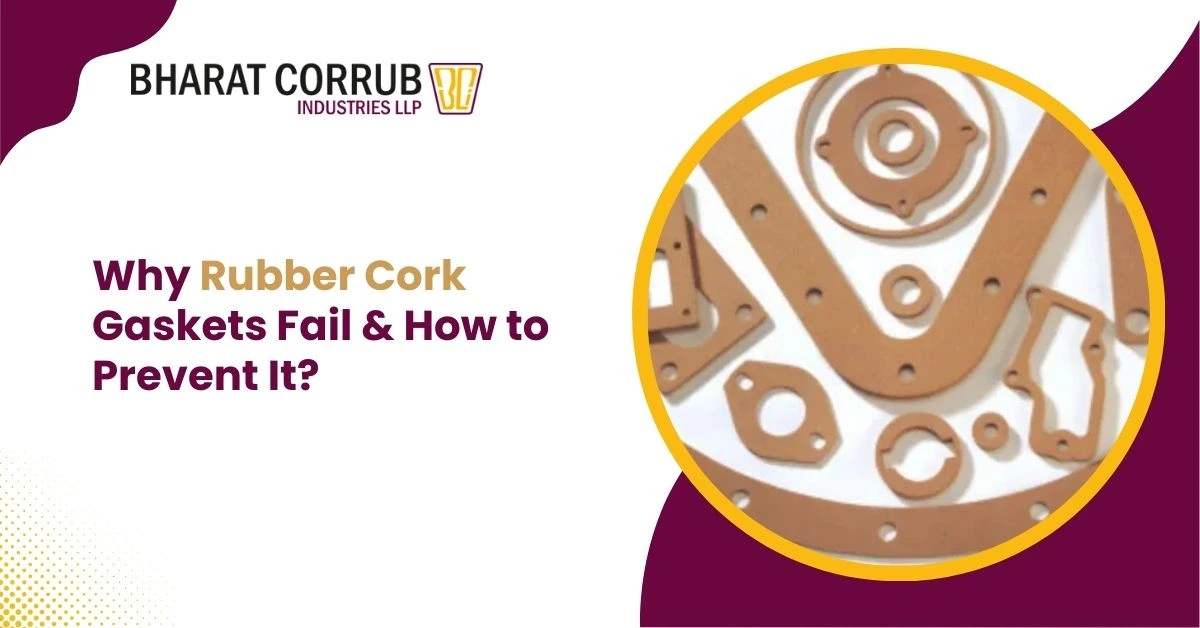
Rubber cork is a high-performance composite material created by bonding natural cork granules with industrial rubber binders such as nitrile or neoprene. The cork component gives the material excellent compressibility and recovery, allowing it to conform easily to uneven or rough surfaces. The rubber binder adds strength, flexibility, and resistance to oils, moisture, and mechanical wear, which greatly improves durability.
Because of this unique structure, rubber cork works extremely well as a gasket and vibration-damping material. It maintains stable sealing pressure over long periods and resists squeezing out from between flanges under bolt load. These properties make rubber cork ideal for flange gaskets, inspection covers, machinery housings, HVAC joints, and pump and compressor sealing, where reliable sealing and vibration control are critical.
What Is Rubber Sheet?
Rubber sheet is a solid, continuous elastomeric sheet manufactured from materials such as neoprene, nitrile (NBR), EPDM, silicone, or natural rubber. Each type of rubber sheet offers specific properties, such as oil resistance, weather resistance, heat tolerance, or chemical resistance, depending on the formulation.
Rubber sheets are widely used for general-purpose gaskets, waterproof linings, protective barriers, industrial padding, and flooring. They provide good elasticity and surface sealing on smooth, flat joints. However, under heavy bolt loads or uneven surfaces, some rubber sheets can experience lateral flow (squeeze-out) and compression set, which may reduce long-term sealing performance when compared to rubber cork.
Rubber Cork vs Rubber Sheet – Composition & Structure
The structural difference between rubber cork and rubber sheet plays a major role in how each material performs in sealing and vibration control. Rubber cork contains millions of microscopic cork cells filled with air, embedded within a rubber matrix. When compressed, these cells collapse and rebound, creating counter-pressure that helps the material return to its original thickness. This gives rubber cork true compressibility with minimal sideways flow, which is especially important for gasket applications.
In contrast, rubber sheet is a solid elastomer without internal air cells. While it can compress under load, the material tends to flow sideways more easily, especially in softer grades. This can lead to thinning, extrusion, or loss of sealing force in bolted joints over time. As a result, rubber cork is often preferred in flange and cover gaskets, where maintaining thickness and sealing pressure is essential for long-term leak prevention.
Rubber Cork vs Rubber Sheet – Sealing Performance
Rubber cork is especially effective for sealing uneven or rough flanges because it compresses easily and conforms to surface irregularities. The cork structure inside rubber cork creates counter-pressure that helps the gasket maintain its thickness and sealing force even after long periods under bolt load. This makes rubber cork highly reliable for flange gaskets, inspection covers, valve covers, and machinery housings, where preventing leaks over time is critical.
Rubber sheet, on the other hand, provides good sealing on smooth and well-machined surfaces. However, softer rubber sheets can suffer from compression set and lateral extrusion when exposed to continuous pressure. Over time, this may reduce sealing effectiveness, especially in joints that experience vibration or temperature changes.
Rubber Cork vs Rubber Sheet – Vibration & Noise Damping
Rubber cork is widely used as an anti-vibration and noise-damping material because of its unique internal structure. The cork cells compress and rebound as vibration occurs, absorbing mechanical energy and preventing it from spreading through the structure. This helps reduce resonance, noise, and mechanical stress in equipment.
Rubber sheets can also provide vibration damping, but they usually require special formulations or greater thickness to match the performance of rubber cork. In applications such as compressor bases, pump mounts, HVAC systems, motors, and generators, rubber cork often delivers more consistent and long-lasting vibration isolation.
Rubber Cork vs Rubber Sheet – Chemical & Oil Resistance
The resistance of both rubber cork and rubber sheet to oils, fuels, water, and chemicals depends on the type of rubber used in their formulation. Rubber cork with a nitrile binder is commonly selected for applications involving oils and lubricants because it resists swelling and degradation.
Rubber sheets are available in various formulations as well. Nitrile rubber sheets are used for oil resistance, EPDM sheets offer excellent weather and ozone resistance, and silicone sheets provide high-temperature stability. The best material choice depends on the specific fluid exposure, temperature range, and operating environment. Selecting the right grade ensures longer gasket life and better sealing performance.