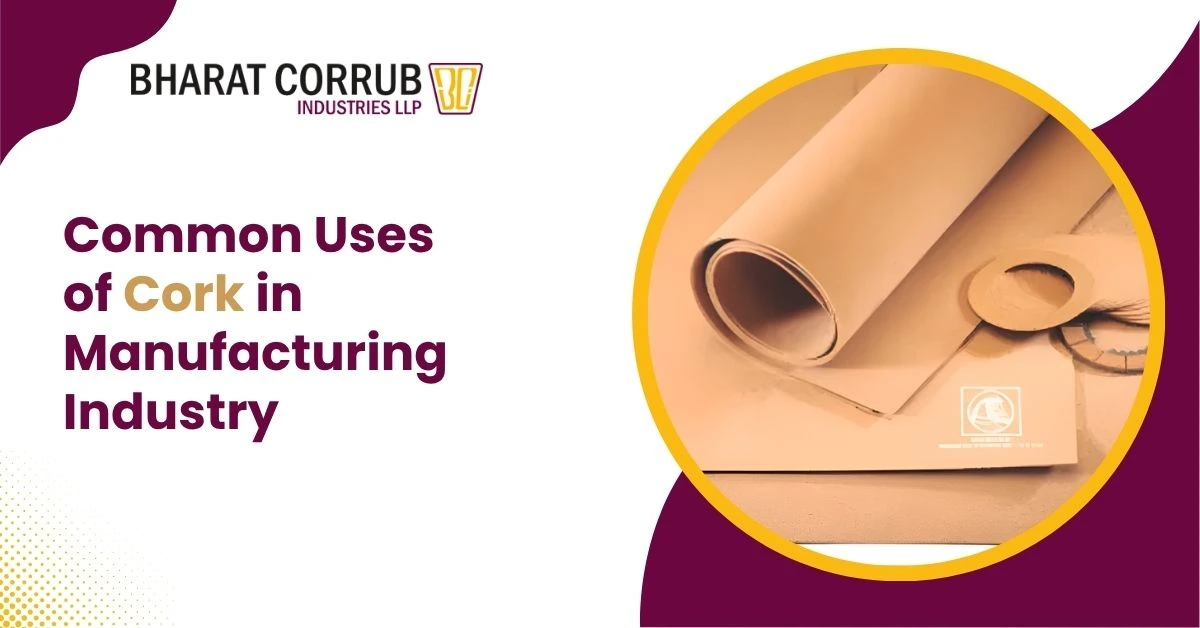
The manufacturing industry depends on materials that can perform reliably under pressure, temperature variations, and continuous mechanical stress. Cork has become a widely used material in this sector because of its natural flexibility, compressibility, and insulation properties. Its unique cellular structure allows it to adapt to different industrial conditions while maintaining consistent performance over time.
In modern manufacturing processes, Cork is not only valued for its functional benefits but also for its ability to improve efficiency and reduce operational challenges. It helps in minimizing leakage, controlling vibration, and maintaining insulation, which directly contributes to better product quality. This makes cork a reliable and practical material for a wide range of industrial applications.
What is Cork and Why it is Used in Manufacturing?
Cork is a natural material derived from the bark of cork oak trees, known for its lightweight and elastic structure. Its internal composition consists of air-filled cells, which provide excellent compressibility and recovery properties. This allows cork to absorb pressure and return to its original shape, making it highly effective for industrial applications.
Manufacturers prefer Cork because it offers a balance of durability and flexibility while also being resistant to moisture and environmental conditions. It can perform effectively in both high-pressure and variable environments, making it suitable for multiple manufacturing processes. Its ability to maintain performance over time adds to its value in industrial use.
Applications of Cork in Manufacturing Industry
Cork is widely used across different manufacturing sectors due to its ability to perform multiple functions efficiently. It is commonly used in applications that require sealing, insulation, and vibration control, where maintaining consistency and reliability is essential for smooth operations.
Industries rely on Cork because it improves system efficiency and reduces the chances of failure in critical components. Its adaptability allows it to be used in both small-scale precision parts and large industrial machinery, making it a versatile material in manufacturing.
Common Applications:
- Gaskets and sealing components
- Thermal and electrical insulation
- Vibration damping systems
- Automotive parts and assemblies
- Industrial machinery components
Use of Cork in Sealing and Gasket Manufacturing
One of the primary uses of Cork in manufacturing is in gasket and sealing applications, where preventing leakage is critical. Its compressibility allows it to conform to irregular surfaces, creating a tight seal that prevents the escape of fluids and gases. This improves the overall efficiency of machinery and systems.
Additionally, Cork maintains its sealing performance even under pressure and temperature changes, which makes it suitable for demanding industrial environments. Its long-lasting nature reduces the need for frequent replacements, making it a cost-effective solution for manufacturers.
Cork in Insulation Applications
Cork is highly effective as an insulating material due to its low thermal conductivity and resistance to heat transfer. It helps maintain temperature stability in systems, reducing energy loss and improving operational efficiency. This makes it valuable in both thermal and electrical insulation applications.
In electrical systems, Cork acts as a protective barrier, preventing heat and electrical flow from affecting equipment performance. Its ability to provide consistent insulation over time ensures safety and reliability in manufacturing processes, especially in sensitive environments.
Cork for Vibration Control and Noise Reduction
Machinery used in manufacturing often generates vibrations and noise, which can affect performance and lead to equipment wear. Cork is used as a vibration-damping material because it absorbs mechanical stress and reduces the impact of continuous movement.
By using Cork, industries can minimize noise levels and protect machinery from long-term damage caused by vibration. This improves working conditions and extends the lifespan of equipment, making cork an effective solution for maintaining stability in manufacturing systems.